
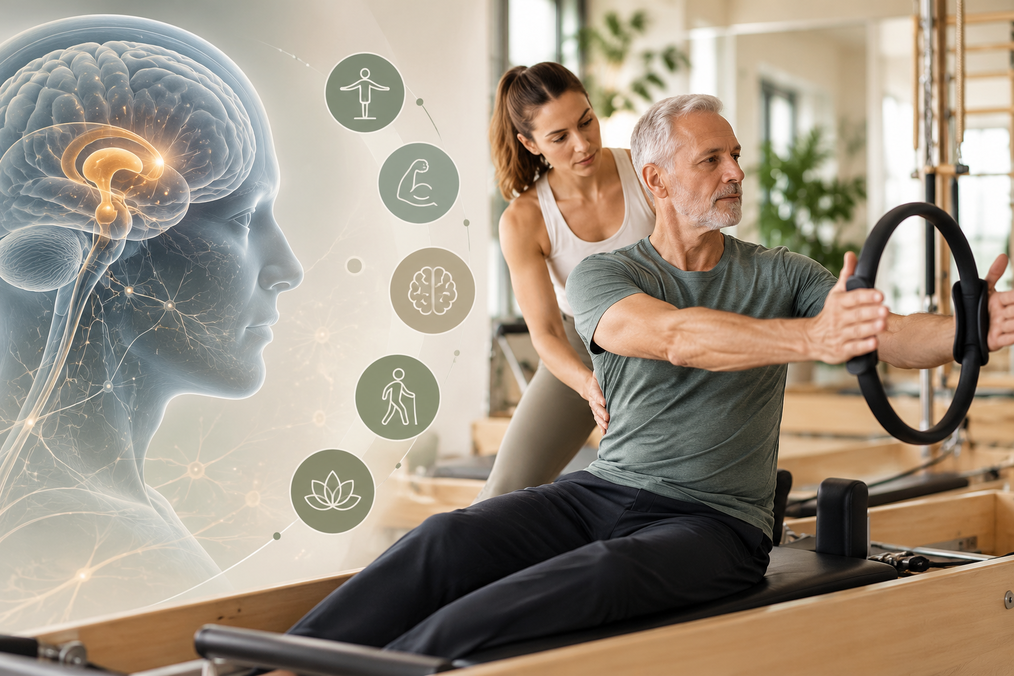
A 2019 systematic review found potential benefits from Pilates for fitness, balance and functional independence in people with Parkinson’s disease. However, researchers called for larger, stronger studies, and current evidence does not show that Pilates slows disease progression.
A new information paper from Clinical Studio Pilates Lisboa examines what research currently says about Pilates and Parkinson’s disease. It presents Pilates as a potentially useful complement to broader exercise programmes, particularly for strength, mobility, postural control, balance and body awareness, while stressing that it is not a replacement for medication, neurological care or prescribed rehabilitation.
The paper cites a 2019 systematic review and meta-analysis covering eight studies, including four randomised clinical trials. Those studies identified potential improvements in physical fitness, balance and functional autonomy. However, the review also highlighted the need for larger and methodologically stronger research. Other reviews have continued to report encouraging findings, but the available studies remain constrained by small participant numbers, differing Pilates programmes and variation in the outcomes measured.
The document outlines four possible areas in which Pilates may support people living with Parkinson’s: trunk control and postural awareness; balance and coordination; muscular strength and joint mobility; and concentration and body awareness. Mat and Reformer exercises can be adjusted by changing resistance, range of movement, pace and complexity. The paper emphasises that the appropriate level of challenge matters more than performing the most demanding exercise.
Individualisation is presented as central because Parkinson’s symptoms can vary widely, including balance difficulties, freezing of gait, fatigue and involuntary movements. The paper recommends stable support, clear instructions, adapted transitions and rest periods where appropriate, with input from health professionals for people experiencing significant balance problems or complex symptoms. For the international Pilates community, the message is one of cautious integration: Pilates may have a useful role within a broader, personalised exercise strategy, but current evidence does not establish that it is superior to other forms of exercise or capable of delaying disease progression. The paper is dated 18 October 2026 and includes a medical disclaimer stating that it is informational and does not replace individual medical advice.
Source: Press release Clinical Studio Pilates Lisboa