
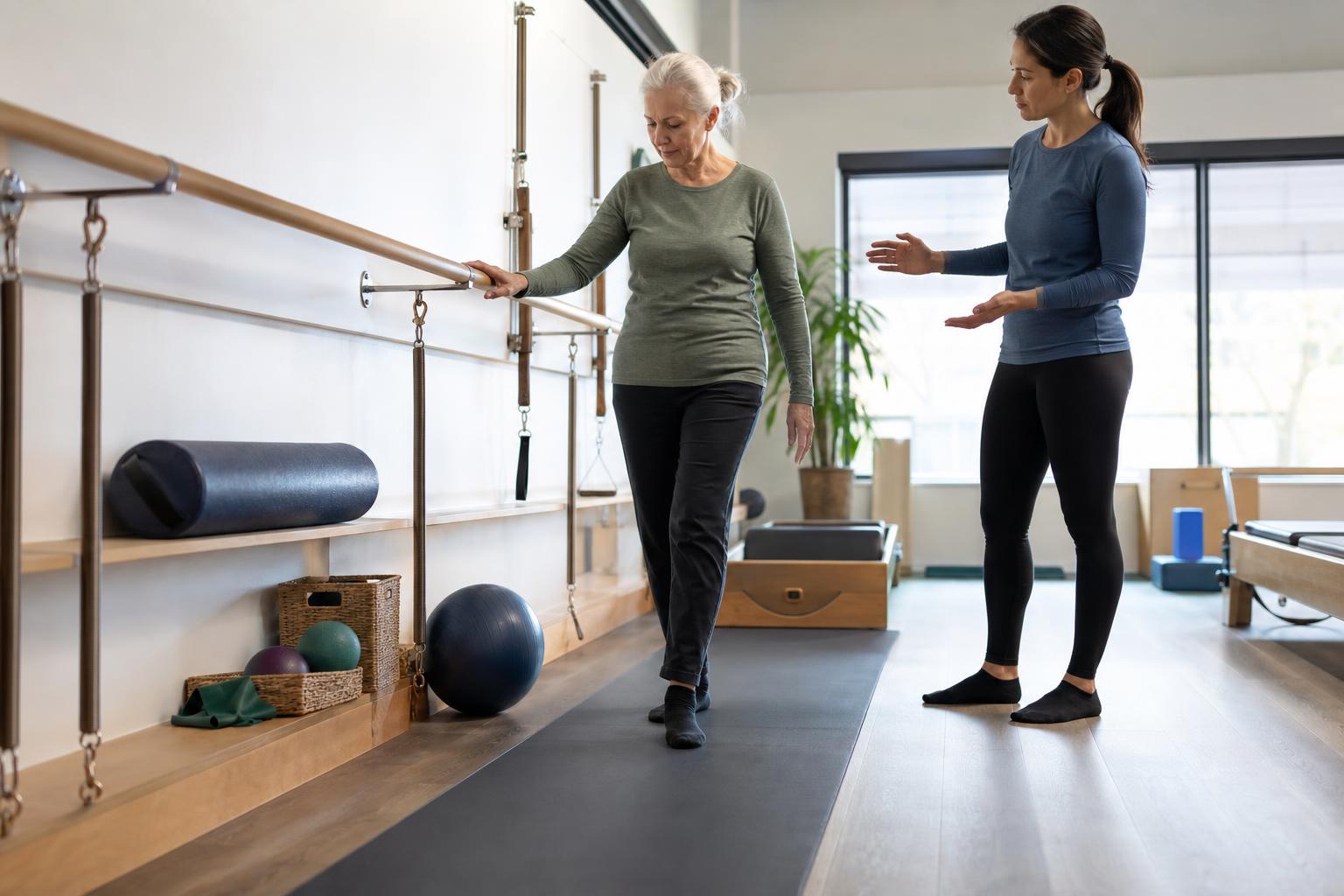
The Pilates 4 Parkinson’s Method places spinal mobility before gait work, arguing that posture and walking should be trained as connected aspects of movement rather than separate impairments.
A Pilates-based approach to Parkinson’s exercise is placing spinal mobility, posture and gait within one progressive sequence. The framework, described by Cecilia Pulido, argues that rigidity and reduced automatic movement affect the whole organisation of the body, making isolated posture or walking drills less likely to transfer into daily activity.
The proposed sequence is “Upright → Mobilize → Integrate → Walk”. It begins with establishing an upright position, followed by spinal and related mobility work, integration of movement relationships, and finally gait practice. The source article places particular emphasis on thoracic rotation and extension, alongside hip-flexor opening and coordinated arm movements, before asking clients to increase stride length or walking speed.
The approach treats posture as dynamic rather than as a position that clients should simply hold. Pulido’s method uses attention to the feet, visual focus, breathing and external cues to improve sensory awareness and movement organisation. The article also highlights the role of the foot in walking, describing progression through heel, forefoot and toes before integrating the rest of the kinetic chain. Structural factors such as scoliosis are identified as issues to consider early in programme design.
For the international Pilates community, the model is relevant because it presents Pilates as a coordinated movement system for neurological exercise, rather than a collection of individual exercises. It also supports more individualised programming: the article says that people with greater rigidity may need more emphasis on thoracic mobility, extension and opening work, while intensity and progression should reflect each person’s presentation rather than Parkinson’s stage alone.
The claims are presented through Pulido’s more than 20 years of experience and the Pilates4Parkinson’s Method, which the source describes as research-informed. However, the article does not provide study results, participant numbers, comparisons or outcome data. Its proposed benefits—including more efficient walking, confidence and movement independence—should therefore be understood as the method’s rationale and practitioner perspective, not as established clinical findings.
Read the full article:
Parkinson’s Exercise: Why Spine, Posture and Gait Should Be Trained Together — The Pilates Journal
Image: AI-generated illustration.