
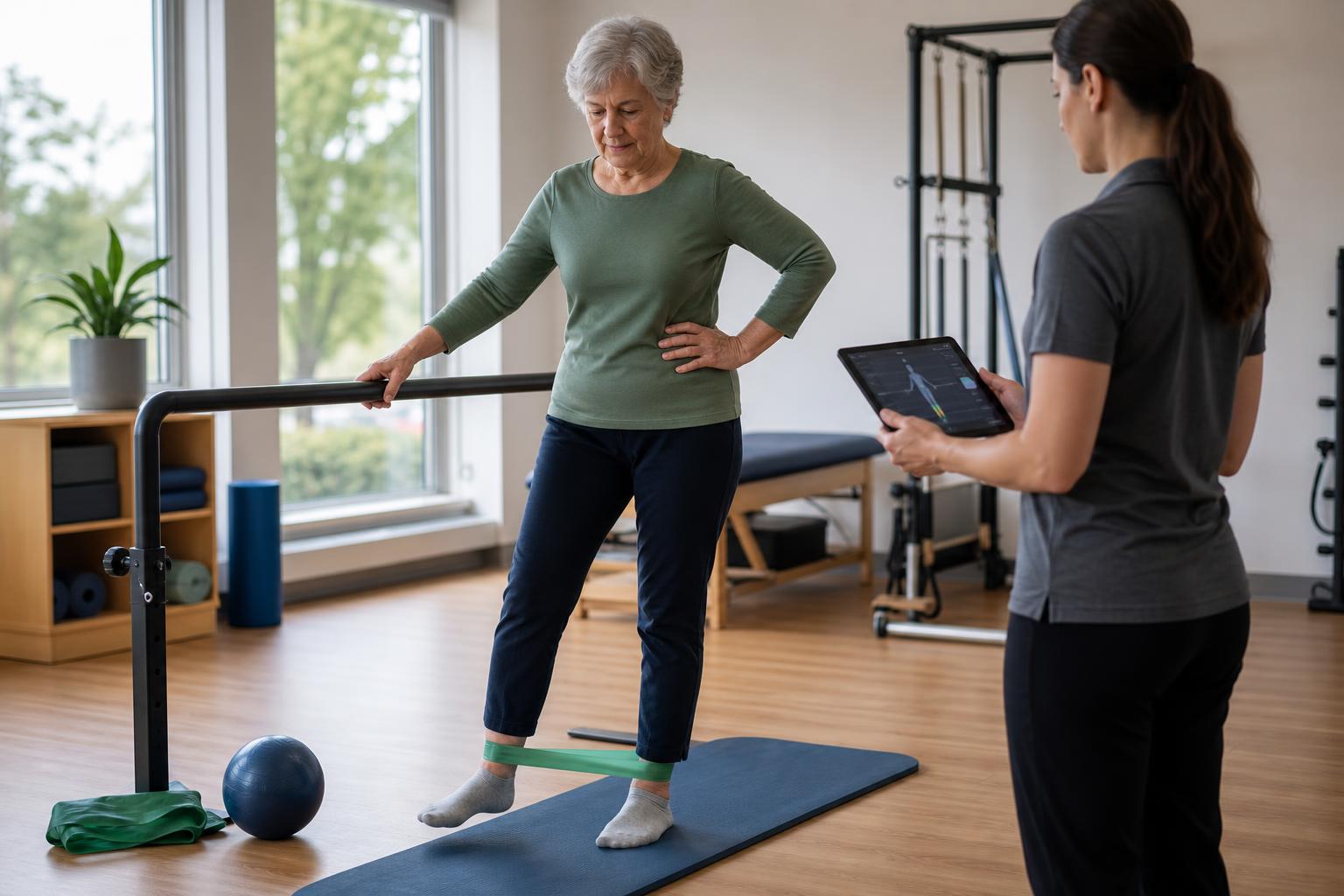
A 2026 systematic review comparing Pilates with technology-assisted exercise finds generally favourable balance outcomes, but says the evidence is too limited to rank methods or support claims about digital superiority.
A new systematic review and exploratory network meta-analysis has examined how Pilates, technology-assisted exercise and conventional exercise compare for balance and postural control in older adults and rehabilitation populations. Published on 7 August 2026, the review brings Pilates into a broader discussion about digitally supported movement programmes and ageing-related independence.
The primary analysis included 12 randomised studies, 25 analytic arms and 491 participants. Compared with control conditions, Pilates produced a favourable estimated effect for balance and postural-control outcomes, as did technology-assisted exercise and technology-delivered Pilates. However, the review found overlapping confidence intervals between active approaches, meaning the results do not establish that one method is better than another.
The evidence base included community-dwelling older adults as well as people with multiple sclerosis, chronic stroke and Parkinson’s disease. Technology-assisted exercise covered a wide range of formats, including virtual reality, motion-sensing exercise, exergaming and remote delivery. Technology-delivered Pilates mainly involved synchronous video, telerehabilitation or other digitally mediated supervision, rather than artificial-intelligence systems or automatically personalised training.
For Pilates professionals, the most relevant finding is not a new prescription but a clearer boundary around what the research can currently support. Pilates may be a useful component of structured balance-oriented exercise, while digitally delivered sessions could help people facing transport or access barriers. The review does not demonstrate reduced fall incidence, long-term preservation of function or superiority for remote Pilates. It also stresses the importance of supervision, screening, connectivity, digital literacy, privacy and referral pathways for higher-risk clients.
The authors rated certainty as low for technology-assisted exercise and very low for Pilates and technology-delivered Pilates. That makes the study valuable for instructors, educators and programme planners precisely because it resists oversimplification. Future research will need larger, clearly defined populations and outcomes such as falls, adherence, safety, cost-effectiveness, durability and digital equity before studios or healthcare providers can make confident platform or delivery decisions.
Image: AI-generated illustration.