
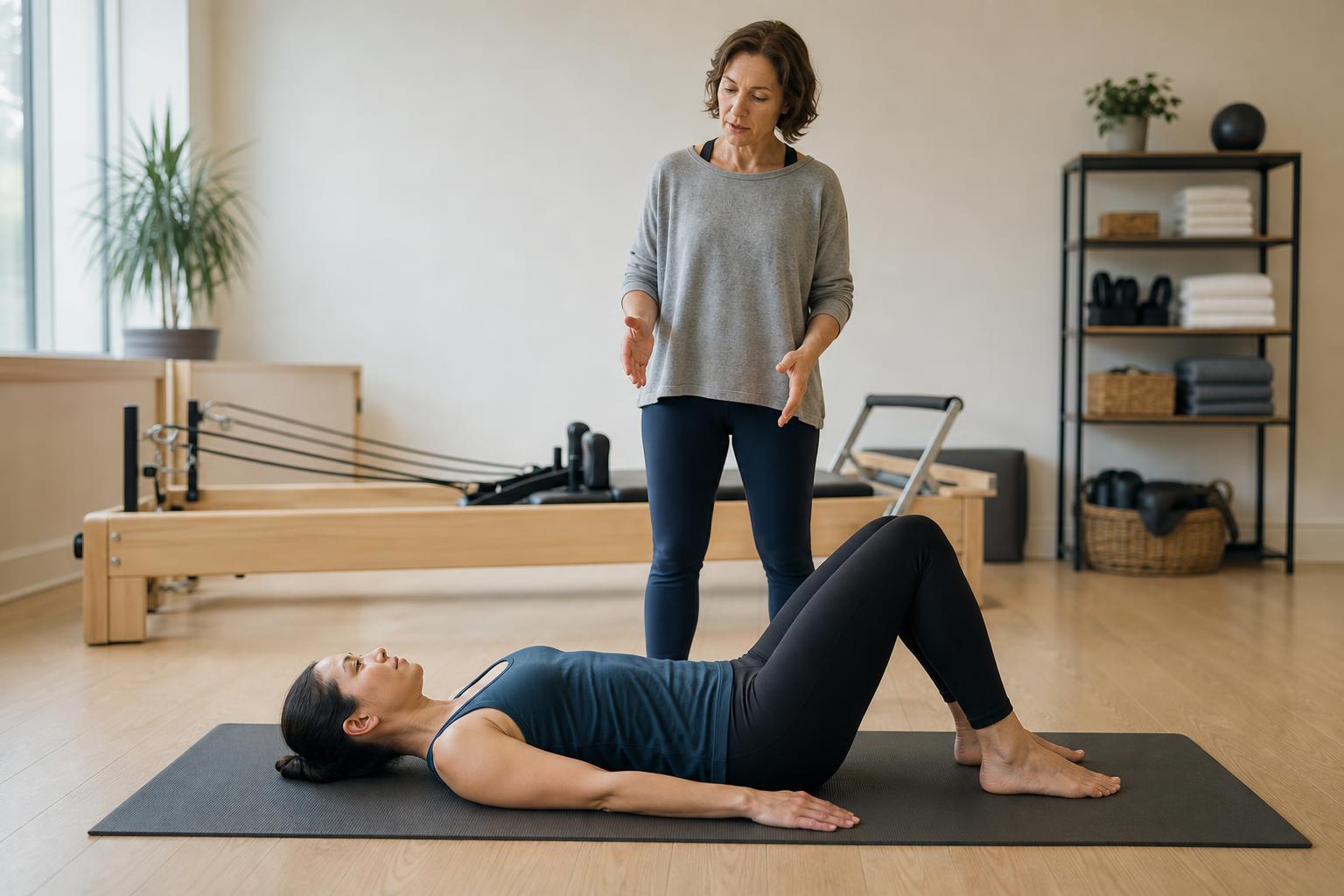
A recent Fit&Well article highlights a common teaching challenge: beginners attempting advanced Pilates variations before developing basic control, alignment and breath coordination. The advice reinforces the value of progressive instruction and appropriate modifications.
Beginners who rush into advanced Pilates exercises may undermine the movement quality that the method depends on, according to a recent Fit&Well article published on 20 October 2026. The article draws on guidance from Marina Enright, a certified instructor and founder of Amare Pilates, who identifies premature progression as a common mistake among new practitioners.
Enright says beginners may compensate with the neck, shoulders or lower back when they attempt movements that require more strength and control than they have developed. The article notes that repeatedly using these compensations can reinforce poor movement patterns and may contribute to discomfort. These are instructor observations rather than findings from a new clinical study, so they should not be presented as proof that advanced Pilates causes injury.
The practical recommendation is to prioritise movement quality over repetition speed or exercise difficulty. Enright encourages beginners to establish a foundation through controlled movement, attention to alignment and coordinated breathing. She also presents modifications as a normal part of learning rather than a sign of weakness, allowing instructors to adjust exercises while maintaining the intended principles of control and body awareness.
For Pilates teachers, the story is a useful reminder that progression should be individual rather than driven by social-media demonstrations or the visual appeal of demanding exercises. Clear regressions, careful observation and patient cueing can help clients build the capacity required for more complex work. Enright also recommends qualified instruction for people pursuing a specific goal or returning after injury, although the article does not provide medical guidance or assess any particular rehabilitation programme.
The advice has relevance beyond beginners. Studios and online educators increasingly need to balance accessible content with responsible progression, especially when short videos can make technically demanding movements appear immediately achievable. The central message is straightforward: a simpler exercise performed with control may provide more meaningful instruction than an advanced variation performed without it.
Read the full article:
The one mistake nearly everyone makes when they start Pilates—and how to avoid it
Image: AI-generated illustration.