
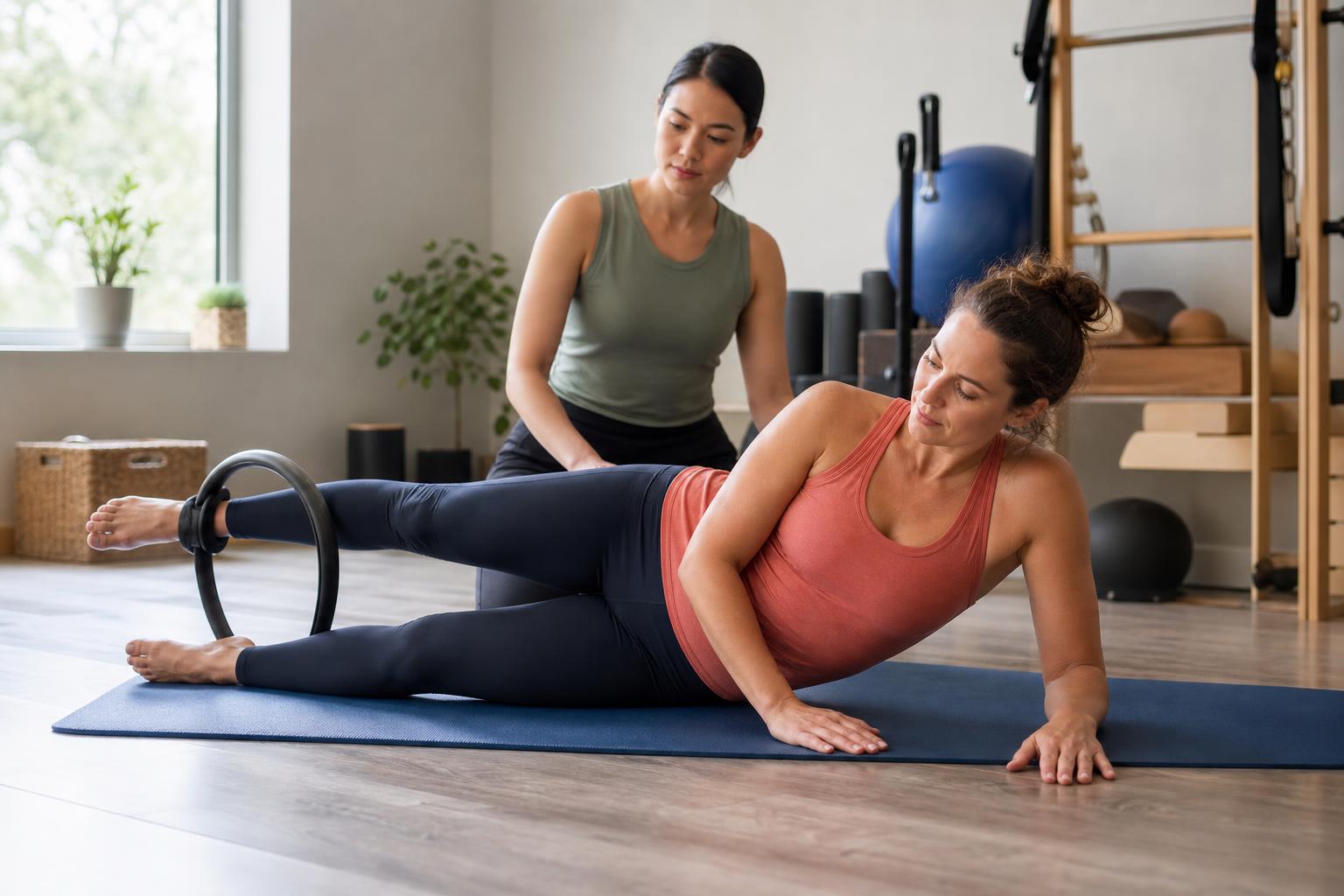
A new Fit&Well feature examines how the Pilates ring can add light resistance while encouraging precision, balance and postural control—offering instructors a practical tool for teaching movement quality rather than simply increasing load.
The Pilates magic circle is receiving renewed attention as a simple tool for developing controlled movement and body awareness. In a 6 October 2026 feature, Fit&Well spoke with Nikkii Behrens, founder of Rare Street Pilates, about how the lightweight resistance ring differs from conventional dumbbells and where it can fit into a balanced training programme.
Behrens describes the ring as a way to introduce gentle resistance without making maximum force the main objective. Her explanation is relevant to instructors working with clients who need to refine alignment, stability and coordination: the circle can provide immediate feedback when a client loses pelvic control, changes spinal position or relies on momentum. Fit&Well notes that weights and precision equipment are not interchangeable, and presents the ring as a complementary tool rather than a replacement for strength training.
The article outlines three examples: a dead-bug variation using the ring between the knees, a squat combined with pressing the circle, and a side-lying leg-lift series. These exercises are presented as ways to challenge the deep trunk, inner thighs, shoulders, hips and postural muscles while maintaining deliberate control. The side-lying sequence particularly emphasises keeping the pelvis still as the legs move, a teaching point that can be adapted for mat classes, small-group sessions or home practice.
For Pilates professionals, the value is less about the ring being a superior piece of equipment and more about its versatility as a cueing and resistance device. It is inexpensive, portable and suitable for a range of movement patterns, but the article is an instructor-led feature rather than independent research. Claims about muscle activation, posture or reduced back pain should therefore be treated as teaching perspectives, not established clinical outcomes. Instructors should still scale exercises to the individual and prioritise safe, precise execution over intensity.
Read the full article:
Fit&Well
Image: AI-generated illustration.