
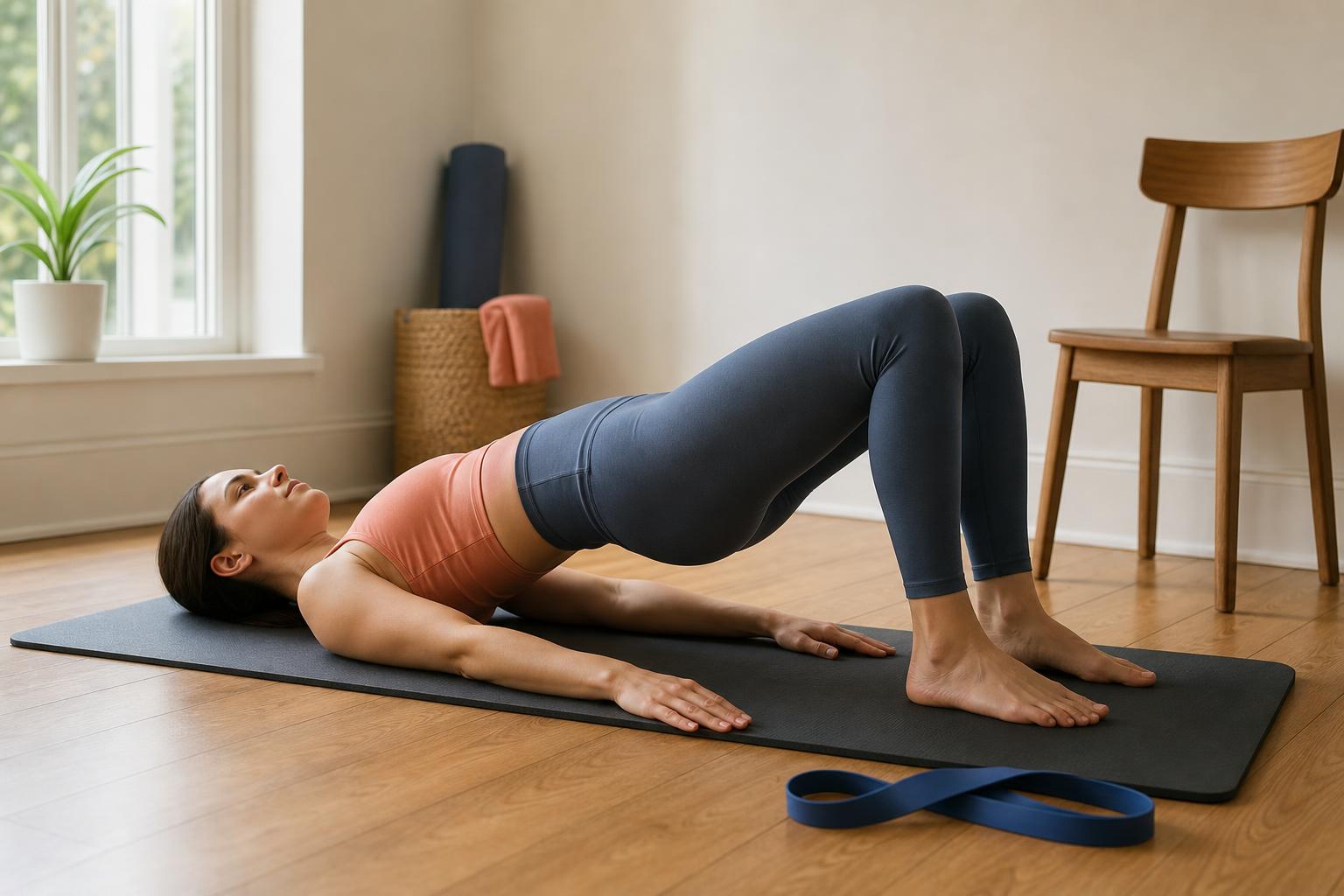
A Fit&Well feature published on 24 September examines how Mind Pilates founder Daisy Zhang adapts Cadillac and Reformer principles into a beginner-friendly home routine using only a mat and resistance band.
A recent Fit&Well feature explores how Cadillac Pilates principles can be adapted for people who are new to the method or unable to attend a studio. Published on 24 September 2026, the article presents a five-move routine developed by Daisy Zhang, founder and instructor at New York-based Mind Pilates.
The Cadillac is described as a large apparatus with adjustable springs, bars and straps. Unlike a simple mat workout, it can offer both support and resistance, which Zhang says may make movement feel more approachable for beginners and people returning to exercise. The article does not present this as clinical evidence, however: its claims are based on instructor guidance and practical adaptation rather than a new study or controlled trial.
Zhang’s home sequence uses a mat and resistance band to reproduce some of the qualities she teaches on the Cadillac or Reformer. The movements include a pelvic bridge, bodyweight squat, step-back lunge and standing roll-down, with instructions emphasising controlled pacing, alignment and the use of a wall or chair when balance support is needed. Readers are advised to begin with one round and build gradually to two or three rounds.
For instructors and studio owners, the development reflects a continuing divide between apparatus-based teaching and the growing demand for accessible home practice. The article’s value lies less in presenting a new workout breakthrough than in showing how an educator translates equipment-based concepts into simpler movement options without claiming that a mat and band are equivalent to a Cadillac. That distinction is relevant internationally as teachers consider how to support clients between studio sessions while keeping expectations realistic.
The piece also reinforces the importance of clear instruction when Pilates is practised outside supervised settings. Zhang’s recommendations focus on control, alignment and consistency rather than intensity. Those are useful teaching principles, although the article should not be read as medical advice or as evidence that the routine treats injury, pain or posture-related conditions.
Read the full article:
A Cadillac Pilates instructor says this low-impact home workout is ideal for anyone new to Pilates
Image: AI-generated illustration.